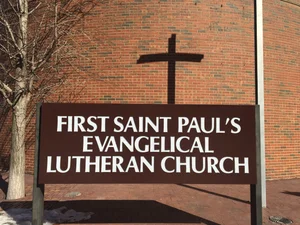
Original sermon given on The Ninth Sunday after Pentecost, July 26, 2026 written and delivered by Pastor Jeff Leininger at First Saint Paul’s Lutheran Church.
Watch the sermon live.
“A Plethora of Parables”
Matthew 13.31-33, 44-52
A Plethora of Parables
In the name of the Living God and the risen Christ. Amen.
Our Lord sets before us a plethora of parables this morning. They initially seem a bit random — five or six little stories or similes thrown together just to make sure they get into the Bible — as if St. Matthew was writing under deadline but still had some good material leftover.
Upon closer examination, we’ll find some important and powerful themes about the kingdom. I’m going to feel a little like the “scribe of the kingdom” at the close of the reading, bringing out some old treasures you probably already know, but hopefully some new ones as well.
First, let’s start with a definition of “the kingdom of heaven” or the “kingdom of God.” Jesus uses this phrase throughout his teachings — it’s one of the most common ways he describes what it means to be a Christian — but what does he mean by this? When we hear “kingdom” we think of medieval knights and damsels in distress; or maybe Game of Thrones; or even a special, magical place in Orlando where you can stand in the sweltering heat, buy overpriced food, and pay to be spun around violently until you throw up. (That’s certainly a Magic Kingdom!)
Jesus doesn’t mean any of this when he talks about “the kingdom.” What he is describing is God’s divine activity for us, in us, and through us when we believe in Jesus and are baptized into his name. The kingdom is for us, because God sent his only son into the world on our behalf — to live our life, carry our cross, die our death, and win us eternal life. In this sense, the kingdom is a gift. It is in us, because God’s divine activity is something that we believe and live according to. In this sense, it is a change, a transformation. And it is through us, because the Holy Spirit is activating this divine work through our own words and work, and witness. In this sense it is a service, an outpouring. So, the kingdom is from God, gifted for us; changing us; and using us — all because of Jesus, our brother, savior, Lord, and friend.
Now all the parables Jesus tells here about the kingdom illustrate something of the hiddenness or surprising nature of God’s activity for us, in us, and through us while living in the world. God’s work is not like any other kingdom, or nation, or movement, or ideology, or endeavor, or agenda. It comes with a twist. Christ’s kingdom has a surprising power, a surprising value, and a surprising verdict.
First, the Kingdom of Heaven has a hidden, or surprising power because it is seemingly so small or insignificant. Like a tiny mustard seed, so small that if I held one up here, you couldn’t even see it, but it grows into the largest of garden plants, and birds rest and nest and play and sing in its branches. Or just a bit of yeast, worked or kneaded into 55 pounds of flour, leavens the whole batch of bread.
God’s divine activity for us, in us, and through us is seemingly so insignificant — it uses no weapons, establishes no boundaries, costs no money, requires no buildings — and yet it has changed the whole world and leavened every one of our hearts such that we can never be the same again. So seemingly small and insignificant, yet it grows into something so incredibly powerful.
I think of “Michael,” a community leader from the Datoga Taturu nomadic people in Tanzania. He’s so passionate about having the Bible translated into the heart language of his people, because he knows it alone has this hidden, mysterious, surprising power to change everything for them. Those seeds planted will surely grow into trees of life for them.
The Kingdom has a hidden, surprising power, but also a hidden, surprising value. Only the man in the parable knows the true worth of the field — that it’s not about the field, but what’s hidden in it. And he doesn’t care how much it costs, or what it takes, for he’s discovered something so life changing that he’ll sacrifice everything else to possess it. Or the pearl merchant: not anyone can evaluate the type and quality of pearls, so incredibly valuable in Jesus’ day — but this merchant can. He knows, he’s found it, and nothing else matters to him. He’ll sell everything else just to have it.
We also recognize the incredible, priceless treasure of God’s divine activity for us, in us, and through us. It is worth more than all the money in your bank account; more faithful than any friend you could ever have; deeper than the ties of family or tribe or nation or heritage; more powerful than the greatest armies; more lasting even than the fabric of the universe. It’s worth everything, and even if we give up everything for it, it’s still ours forever.
So, the divine activity of the kingdom of God for us (gift), in us (change), and through us (service and witness) has a hidden, mysterious, surprising power in comparison with the world — it seems so small but does so much; and a hidden, mysterious, surprising value — it appears from the unbeliever’s perspective as worthless, but in fact it’s more valuable than anything. And, thirdly, the kingdom has a surprising verdict (or judgement) in the end.
A net is cast out into the sea, and it gathers all at once all types of fish. Like the parable of the wheat and the weeds from last week, they’re gathered all together, hard to distinguish one from another. All in one big field; all one big net of humanity.
But there is a final divine sorting — a separation between those possessing the kingdom and those not. This is hard to talk about, even think about sometimes. But its truth is inescapable, for a last judgement is taught all throughout scripture and indeed, we confess it weekly in the creed: “he will come to judge the living and the dead.”
But here’s the surprising twist. The final verdict, last judgement will not be about how much money you made, or how many likes on Facebook, or how many friends you had, or what your gorgeous body looked like, or how many games you won, or degrees you earned, or worlds you conquered, or towers you built, but solely this: what did you do with the kingdom of Heaven — the divine activity of Jesus, gifted to you, transforming you, outpouring through you? This is the ultimate reckoning, the final grade, the end of life exit interview, the last, eternal gavel pounded down.
That’s why it’s so important that we’re here together this morning. We so easily lose sight of the kingdom at work for us, in us, and through us. We strive after less valuable things; seek belonging in less meaningful things; hope for but fleeting things; live for temporary things. But the one who first told us about the kingdom, and who in his person and work brought it about — the living Lord Jesus — he’s here for us this morning. Once more calling us out but also calling us back and sending us forth. In Holy Baptism that little mustard seed was implanted in us; in Holy Communion we are leavened with the bread of life. In his word he confronts us about all the other kingdoms we seek, but he forgives our sins and covers us with his very righteousness so that we can stand unafraid at the final sorting.
This Jesus gave up everything for us, his priceless treasures, offering his own precious blood on the cross for us. This Jesus conquered sin and Satan for us. This Jesus rose from the grave, defeating death for us. This Jesus ascended into heaven and now rules over all things for us. And this Jesus will return for us one day to establish a kingdom that will never end.
Return to him. Believe in him. Receive from him. Be changed by him. Be found in him.
May his kingdom come among us, and may we always pray:
Come soon, Lord Jesus. Amen.
Image Source: Vermeer, Johannes, 1632-1675. Woman Holding a Balance, from Art in the Christian Tradition, a project of the Vanderbilt University Divinity Library, Nashville, TN. https://act.library.vanderbilt.edu/artworks/59694 [retrieved July 27, 2026]. Original source: https://commons.wikimedia.org/wiki/File:Woman-with-a-balance-by-Vermeer.jpg.